Ana Toledo – Palpable Tweets

For many years in the southern Brazilian city of Curitiba people would see strange, curious signs spread throughout the city; in lampposts, walls, fences. The signs are simple inscriptions written on a white board with capitalized letters usually in blue or black. The messages are describing positive attributes of Brazilian or international celebrities in very superlative terms. They would just show up one day, one at a time and were soon everywhere. Some blogs named the signs hyperbolically as “one of humanities’ biggest mysteries”.

Image
“Gisele Bündchen gets even richer everyday, she is extremely powerful”

When social media became popular, the signs were spread in the form of pictures mainly locally, but soon reaching the rest of Brazil. People thought they were very random, funny and intriguing. Nobody could understand the point of the signs; its randomness being probably the most alluring thing about them as well as the mystery behind who had been producing them all those years.

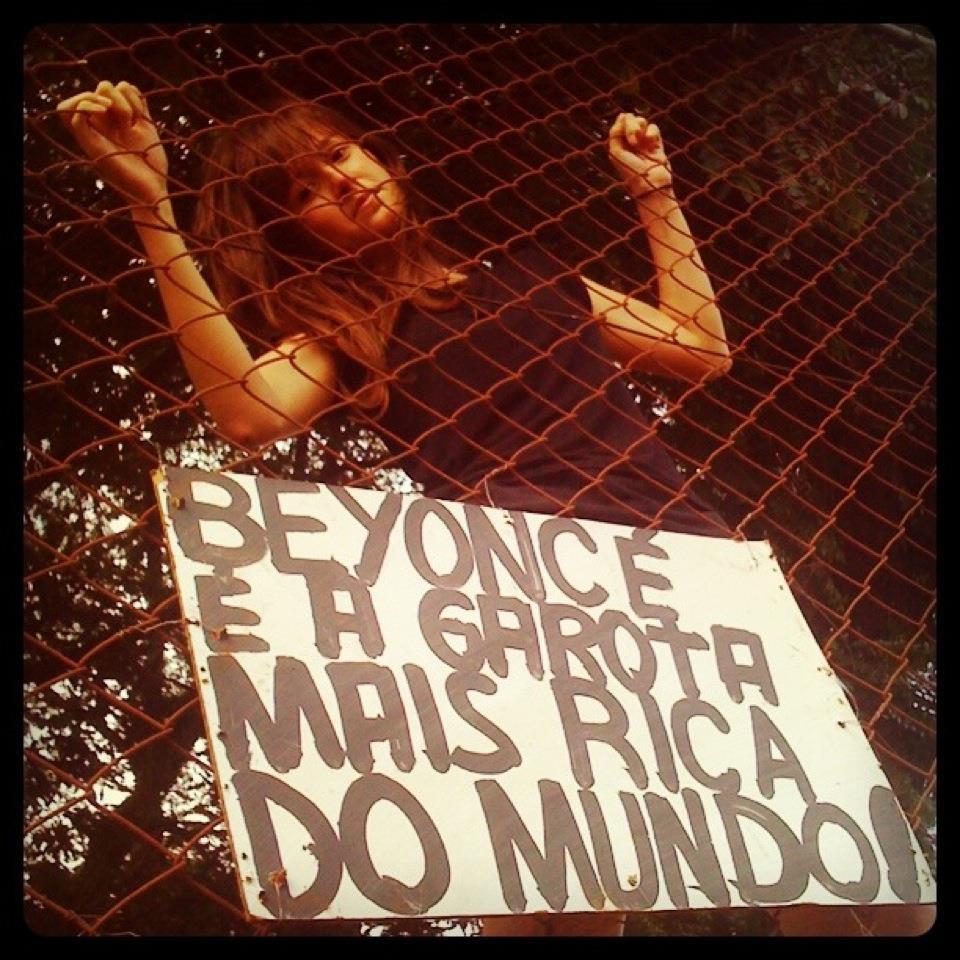
In November 2012 a tumblr called “Poderosíssima e Trilionária” (roughly translating “extremely powerful and trillionaire” in reference to the hyperbolic language of the signs) was launched posting pictures of the mysterious signs. Some of these pictures have people posing with them as the one below.
Image
“Beyonce is the richest girl in the world.”

The author of the signs was finally discovered in August 2013 by a blogger who interviewed him. He turned out to be an unemployed 60 year old man named Sergio Ruiz. Sergio avoided revealing himself because his mother thought the signs he produced were embarrassing. He has been doing his art anonymously and distributed it around the city for almost 20 years, according to him.

Sergio told the interviewer he loved mass media; an avid magazine and newspaper reader and television watcher, he is also fan of comic books. However, Sergio does not use the internet. When asked why he did the signs, he said shyly: “Well… simply for fun. I am a little exaggerated”. He claimed he did not mind people stealing his signs, as often would happen. The city’s administration removal of his signs and the copycats were the ones who upset him. His signs, he would claim, were only in a white background with blue or black letters; any other color was a copycat.

I find the case of the Curitiba signs a very interesting case of media and the shaping of reality. Sergio decorated the city with his humorous signs transforming the world around him with his messages. He modified the urban scenario, even if unwillingly, by spreading his mysterious art, making it part of the city and its everyday life. Sergio, a man who does not use the internet, was spreading palpable tweets about celebrities throughout the streets of Curitiba before Twitter even existed.

Discussing this case with Tiiu Särkijärvi, we noticed that Sergio and his signs had social media-like features; they were spread, copied and reproduced. These were done first on the city environment and later also inside the internet by his fans. Media lover Sergio became a full part of the contemporary social media outlets.

Image
Sergio and one of his famous signs: “The beautiful singer Sandy is the fifth wealthiest woman in Brazil”.

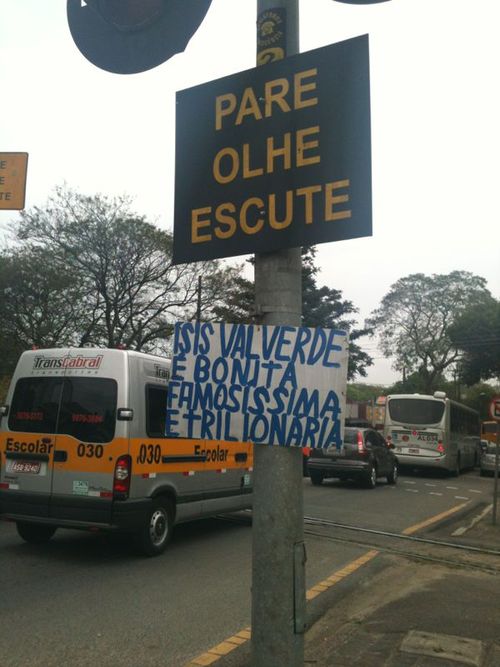
One of Sergio’s signs in a lamppost:
lamppost
“Isis Valverde is pretty, extremely famous and a trillionaire”.

Information was taken from the blogs below. They are, sadly, all in Portuguese only.

http://www.ideafixa.com/desvendando-o-misterio-das-placas-superlativas

http://poderosissimaetrilionaria.tumblr.com/

http://www.imaginarium.com.br/blog/inspiracao/placas-divertidas-espalhadas-pela-cidade/

http://www.youpix.com.br/redes-sociais-2/misterio-placas-elogios-celebridades/
Video Game Escapism

When it comes to technology and media (since usually media demand technology involvement) someone can come along a lot of examples where people want to use media in order to lead to a change or at least this is what they think they are doing. Personally, probably my biggest “achievement” towards changing reality was probably voting, although nothing changes. Maybe my work as a technology editor could lead people to buy or not to buy technology related products, but, maybe reality didn’t change that much in the end. In any case, enough with my personal tryings on changing the route of history and probably enough with my celebrity. I guess I got my few minutes of celebrity.

At this point, and for no particular reason besides the fact that I admire her, I would like to mention Jane McGonical. McGonical is mainly a video game designer, but what is special about her is the fact that she wants to use all this “collective knowledge” which is produced by video game players in order to produce something useful. Against the notion which wants video gamers zombie people without life, McGonical wants to use the energy their spend in order to improve the quality of human life.

For the sake of space and time, this is a short video expressing her ideas. In YouTube if anyone is interested they are more, from speaches to interviews.

Personally, I don’t know if she is overly optimist or not, but it would have been a good idea to take into advantage all these energy which is spended in videogames.

Laida Limniati


Laura Salonen – A resignation that made people think of quality over quantity

A few months ago Marina Shifrin danced away from her current job. She was working for a video producing company and decided to give her resignation by honoring the company she was working for; by making a video. However, she wasn’t very content with this particular company and decided to share her feelings on the video – and then put in on YouTube, of course. In the video Shifrin in dancing to Kanye West song Gone and complaining how she has sacrificed her life and social relationships for two years to this company, and her boss is only paying attention to the number of views her videos are getting. Well, at least this video got millions of views in few days and Shifrin became famous. (Of course the company wasn’t too happy about this and decided to respond her by doing a dancing video of their own.)

Marina wasn’t happy about her job and she could have resigned like a normal person does but she decided to do it in front of millions of people. Why did she do that? I believe that her plan wasn’t only to resign or tell the world what a shitty company she was working for. She wanted to bring forth the issue that most companies in today’s world are facing; focusing on quantity over quality. It’s not only a problem of the companies working with the web (how many likes, views, followers, etc. they get) but it is a reality we are living; focus only on the profit instead of the actual things that the company and its employees are doing and the feelings they are feeling. This is not maybe editing reality itself (making it more media-like) but changing our ways of thinking and editing the ways we see the world. The reality is constructed of the way we think and see our lives. I believe that in some kind of way, Shifrin is hoping to edit not only her reality but trying to do it for all of us who are living in today’s consuming-oriented and quantity-focused world.

Changed reality – Could it be that our Facebook personas are as scripted as reality television?

“These are my wonderfull, talented children” and “this is how much my boyfriend adores me.” The social networking site Facebook is being used by many to create an online identity. But some people argue that Facebook has blurred the boundaries and that identities have become ambiguous. Photoshopped photos just to make you glow that tat bit extra, or just that one more extra status update to state about the vibrant, brilliant, party-filled life you’re leading. But life isn’t always so wonderful and glamorous … at least mine isn’t. But when I check my Facebook and see all the status updates of my friends, they all seem to lead these picture perfect lives, with one highlight after the other. But when I talk to them in person, their lives are far from perfect. And it is typically those ones that rave about their lives on Facebook that are actually the ones who are the loneliest and unhappy. But what is this falsehood that we seem to create in our lives? Do we actually believe the lies that we tell ourselves on Facebook… in other words, are we creating our own reality?

By: Inge F.
University of Helsinki

Yangjuan Hu – Could circusee make a change?

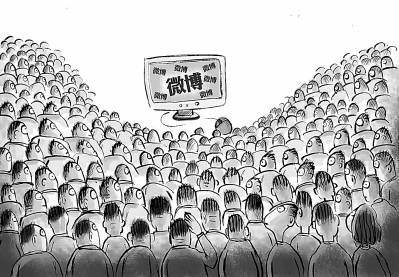
Today’s class gave us some basic concepts about the media life which we are living and three perspectives – artifacts, information and social arrangements – to look at it. As a group of people who are living in media, how can we change reality? This question reminds me of a controversy in China three years ago. In 2011, China saw the rising of social media, especially Weibo, which was a Chinese version of twitter but was more image-friendly than twitter (Chinese government has banned the access to twitter). The controversy came with a slogan which is ‘attention is power, circusee changes China’ (Circusee is a net expression which combines ‘circus’ and ‘see’ meaning to surround and watch an event without actually participate or intervene the event, for example to repost and comment about a protest without actually participate in it). Opinion divided on the question ‘could circusee really change China or ever change anything’.

u262p4t8d3067518f107dt20110526071423

A microblog circusee [china.com.cn]

It’s an interesting question not only in China and not only during that time. It has a common concern in it which is we are so deeply immersed in the media life that we forget about the reality or become indifferent to the reality. Sometimes it seems that all the reposts and comments, share and like are just meaningless. You can shout on Weibo for the freedom of speech for a thousand times but it will not change the reality that your radical shout will be deleted by the authority.
But here I want to use an example to say that sometimes a simple repost does change reality. It’s an online movement initiated by a scholar called Yu Jianrong in China. He encouraged people to take pictures of homeless and begging children they saw and post them on Weibo with a hashtag, so that these pictures could be easily repost and spread, so that parents whose children had been lost or kidnapped could review these pictures and see whether their children are among them. Parents were also encouraged to post pictures of their lost children so that netizens could see whether there was someone they had seen. This movement engaged thousands of hundreds of Chinese netizens and helped to find at least 6 lost children in two weeks, including this boy http://newsfeed.time.com/2011/02/09/after-three-years-internet-reunites-chinese-man-with-kidnapped-son/ who had been lost for three years.

Marie Duperier – Canon advertisement “à vous d’aller plus loin” (go further)

This advertisement is interesting because it claims with a Canon camera you can see the reality in another way which seems to be better. Thanks to a Canon camera the reality becomes better, more funny and exciting, “see the world from another angle”. And the advertising slogan “go further” seems to mean you can create your own reality as you dream and want it. “Rise to your own challenge” seems to mean that with a camera your dreams become real so you turn the reality into your reality. Buy what “reality” ? Reality is what we experience so each person experiences a different reality, can a one single reality exist ? Media don’t separate us from the or a or our reality because they also belong to.
This ad is also funny because it shows the need to have a camera: if you don’t have a camera your travel is nothing because you can’t show and share it. Who travel without camera nowadays ? Our eyes are nore more enough. And we don’t look at the landscape or people but we watch our photos. Our photo, our point of view become more important than the place.

Tiiu Särkijärvi – Cartoons out of reality

I don’t know if my topic directly is about making a change in the world, but it is manipulating reality through media and as a phenomenon I find it interesting. Today in class we briefly discussed the cultural differences when using social media. What I have noticed is that in Finland, the things we post on, for example,  Facebook are often funny. One of the apps that has gained success recently on Facebook is bitstrips, where you can cartoonize yourself and make often hilarious comic strips about your current life situation. Bitstrips advertises itself as an app, with which you can show how you’re feeling. In social media, words are not enough as we have seen with the selfie-craze.

Along the same lines, as Jaakko mentioned in his post, bitstrips can be seen as just another way of creating an alias online, someone who has more comedic value than what we have in “real life”. Even the most simple life situtaions and feelings gain comedic value through the app. One of the themes discussed in class was if media is making us all narcissists and bitstrips could potentially be something that emphasizes this claim. However, the difference between bitstrips and, for example, selfies is that bitstrips definitely has the comedy aspect, whereas selfies often try to show us in a “cool” way. Bitstrips allows you to change your appearance and literally edit the world and image you wish to portray to people. What is interesting about bitstrips is that the cartoon strips, which are ready-made, are often media-related. I leave you with some strips, which unfortunately star me, you can go and create your own at: http://www.bitstrips.com/

bitstrips 1 bitstrips 2

Tytti Rintanen – Running for charity

Some time ago I learned from a classmate, that people are earning money for charity while they work out. This weird phenomenon, where someone sponsors your exercise even if you’re not a professional athlete, became familiar to me already in primary school: we had Unicef Walking -campaigns, where students were sponsored for their kilometers, and the earned money was donated to Unicef. However, this Charity Miles mobile application my friend talked about, seems to take it all to another level. People can decide to support a certain cause whenever and where ever they are walking, running or biking. The application tracks the route and counts the sponsored sum: bikers earn 10 cents per mile and walkers and runners 25 cents per mile. Being healthy and good; this is what I’d call multitasking.

The tricky side of this application (yes, there always is one) is, that in order to earn and donate money you have to post on your social media feed the details of your training. These “Tytti just ran 15 miles with Charity Miles” -type of announcements could cause a massive flight among Facebook friends, at least if we’re to listen to the fears of some of my sporty friends: “It can be interpreted as boasting of one’s self-discipline and charitableness” or “People would think I’m a conceited sporty hypocrite”. Wonder if that would really be the case… as many are posting advertisements to get special offers, already. Anyway, it has been a pleasure to learn that sport related mobile applications are used also for something else than counting the fat burned on the way. And I wonder if activity trackers like Bodymedia can already be combined to this application? Then the mediated multitasking would attain it’s top, I’m sure.

Lauri E. – Re-run your day?

Today we ended the class with a discussion about how new media enables us (and also creates the urge) to change and edit the reality. We in a way want to apply the same media-life-logic of continuous play, pause, edit and delete to our IRL-lives as well.

This reminded me of the latest must have gadget that will be released to the consumer market this year: the ultimate media life device, the Google Glass. By enabling you to video capture everything you see and experience, it also creates endless possibilities of retakes and replays of your experiences as well. What if you could re-run any moment of any given day?

Jete Laanemägi – Media in one single minute

Untitled

After watching Life in a Day in todays class I remembered a small media-project that took place in my home country. The essence of the project was to capture a minute of your life at 1pm on the 24th of February – the Independence Day of Estonia. By that way one minute of history was written down with just photographs. The project was named Eesti Minut (A Minute in Estonia).

I see it as a way to give everyone a chance to do something more beautiful and meaningful than just a regular Instagram caption about your beef carpaccio or your new kicks. This is why I fall in love with my media again and again.

You can view the captions from: http://www.eestiminut.ee/. Choose a county from Vali asukoht and have fun!