
Twitter: @Maybious
Reflections on How and Why We Love Media
Twitter: @Maybious


To sum up, Google has told me I am not journalist, even when I am studying it. Google has told me I am just a girl who likes to make tutorials about Prezi, learn a dificult language with others, who liked to be knowed by strangers when see was younger, etc. Itziar, for Google, is not journalist, and What is the meaning of this in media life? I am not journalist! Yeah, I like the spanish cinema, travel to another countries as “oper” or to make“Prezi” tutorials. But, Is that really what I am trying to be? Well, Google is a good friend, and as allways, he has helped me a lot. In fact, that evening he gave me a good advice: “Itziar, you should concentrate your efforts so as to be productive for your future. You can create a blog and share your Facebook, Twitter and Linkedin, they are good friends too, and they will help you to do so. I can show you to others as a journalist, but you should work for it! Because be boring is confortable, but when you are too confortable you don´t grow up.”
Do we imitate the media in real life? Yes, we do. Not only we live immersed in the media, but even try to play them in real life.
In a series of television in Spain, “Sad life”, the protagonist is inmersed in an absurd story where his entire environment behaves exactly as would do on Facebook. This chapter series is probably inspired by the marketing of “Faceboom” book written by the argentine Juan Faerman, which analyzes the social network, and its functions. In the advertisement I share with you, the man come back home and finds his wife with another man, and she tells him she found him in a party for ex-classmates in primary school and are now friends. After thinking about the situation, the guy answers “then, we are friends” and , at this moment, another guy leaves the wardrobe by saying “I like it”.
http://www.youtube.com/watch?v=wFQPMy86RfE
MuseumSelfie Day has been an initiative which was held January 22 around the world. The idea was to encourage the people to get “selfies” at the museums so as to promote the visit to these cultural institutions.
Another not-so-productive example is the episode starring by Zachary Burgess in 2013. This 20-year-old boy was arrested in Alabama, United States, because he wanted to play the game Grand Thief Auto V in a real way. To do so, he stole a truck, abducted its owner, and slammed it into nine vehicles. The boy was charged with an offence of robbery, kidnapping, escape, as well as damage to parked vehicles.
http://www.youtube.com/watch?v=jZg49S9SBb8
In conclusion, we not only live the media, but we can bring them to the “real life”? for diferent reasons. Maybe we want to create a satire about our behavior; achieve certain goals or realize a fantasy. And this is something which shows us how media life fascinates us.
Itziar P.S
On May 15, 2011, a series of demonstrations took place all over Spain -being the largest at Sol Square in Madrid- days before regional and municipal elections of May 22, 2011. What was the reason? The social cuts and public aid to Banks caused great discredited of the public institutions and politicians. For this reason, more than 20 thousand protesters arrived in “Plaza de Sol” and they camped there that night. 15M movement was born with the intention of being there until election day. On 20 may, the Assembly decided by consensus some proposals and objectives of the movement. While, the international press spoke about what was happening in Spain and 15M began to appear on the international press. On June 12, the Assembly decided to leave the square voluntarily, after 28 days occuoying it.
But the must important fact was that different concentrations in several cities in Spain were possible thanks to the communication technologies and social networks. Soon they were organized via internet and it was possible even to continue demonstrations through streaming video. But, What were the main supports of the movement?
Firstly, Facebook was one of the main agents of communication for the movement with more than 180000 followers. There were also pages of citizen platforms, and lots of pages created as support for the movement –like”Youth without future”, with almost 30,000 friends-.
Secondly, on Twitter the number of “zombie” followers was around 30,000 in accounts as “democraciarealya”, where there was information of protests, links to news about these acts and their authorizations, slogans or the ideology of the movement. What’s interesting here is that according to a research, more than 250 zombies twitted daily “real democracy now!”
Thirdly, the movement had support on the web pages “Real democracy now!” and “Take the square”. On one side, “Real democracy now!” with the slogan “Take on the street 15.05.11” explained who they were and publish their proposals. They also had a forum with sections for mobilization proposals, calendar of events, etc. Moreover, it included links to other channels such as Facebook, Twitter, Youtube, and blogs from local groups. On the other side, “Takes the square” had posted a list of cities which have been held and links to the Facebook page, of “Spanish Revolution”.
To sum up, each “alone” like, each “alone” comment, each “alone” content shared, each page created by a “lonely” person seems to say: we “together” must destroy this system. We are anti-system because the system is anti-citizens. THEY and their system are against ME. We should EAT THEM to SURVIVE.
Itziar P.S.
The idea of being alone together due to media might at first seem a bit creepy: people get alienated from the real world and real social interaction by being always online, using their media even in company. This can’t be a good thing, right? As we talked in class yesterday, being alone together isn’t such a black-and-white, good or bad phenomenon. It has it’s good sides and bad sides, it’s complex. Actually being alone together can bring us more together, make us more social, turn into something good. So our task was to think of examples of how we can be alone together in media in ways that have positive ethical and/or aesthetical impacts in the real world making the world a better or a more fun place. Here are some of the examples I came up with.
One example are the many recycling groups that have been formed on Facebook. There’s for example a group called “Roskalava HKI” (Trash pallet Helsinki) which has over 12 000 members. The idea of the group is that people can share tips on where to find good trash pallets and based on these tips go and pick up usable and useful stuff before they get transported to the dump. There’s also a website called Sharetribe (sharetribe.com) where anyone can start their own online marketplace in order to sell, change or rent goods and services. It’s aimed for both individuals and existing organisations, like the University of Helsinki, which has it own Sharetribe page. I think these kind of groups and websites have both ethical and aesthetical impacts, since it encourages recycling (good for the environment), but also makes life more fun (finding unique furniture on trash pallets can be a real hobby for some people). It also makes it possible to meet new people with the same interests.
Flashmobs are another example that came to my mind. A flashmob is when a group of people gather in a public space, do a quirky performance and then disperse after a short period. Flashmobs are organised through media, like social networking sites, and anyone interested can take part. The point of these performances can vary from making a political or social statement or to just have a laugh and make the world a more fun place. One example of a flashmob that got a lot of public attention in Finland was this one:
It was organised during the last presidential elections to support the other candidate of the final round, Pekka Haavisto. The flashmob was organised entirely via a Facebook group by private people.
Noora H.
I know, that for many people, this might be something very minor and maybe even everyday kind of thing (if we think about conference calls at our work place for example) but for me, what I’m about to tell, was a big part of my four years away from my family and friends.
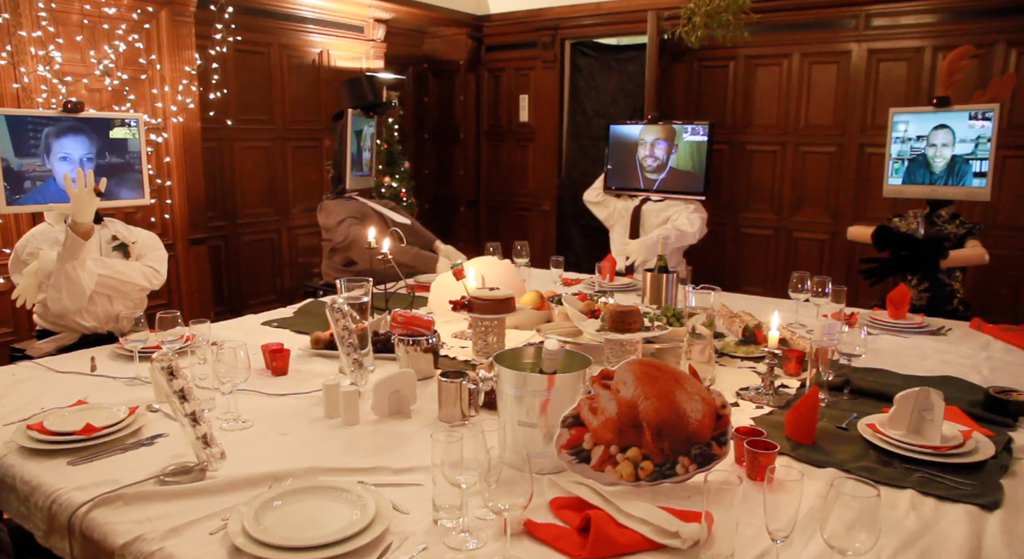
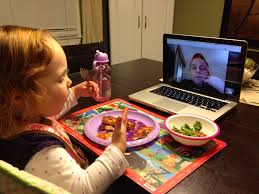
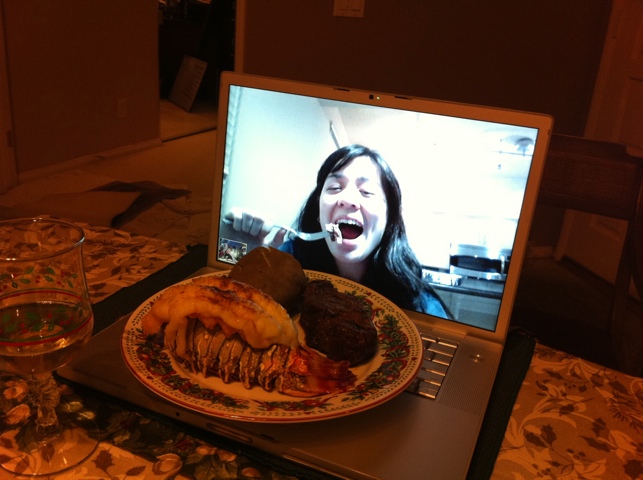
We are used to using multiple media platforms at the same time almost like in a well planned synchronized dance. Lets imagine a dinner table. there’s five people: mom, dad and three sisters. But there are couple of things slightly different here because two of the sisters are not actually there, I mean physically, one is in London and the other is in Turku ( a city in Finland). Well to be honest the third one is not there either. She’s actually concentrating on her Iphone and instant messaging to three of her friends who are also having their dinner somewhere in Helsinki. But how all these people are together then? Well there are two laptops on the table, right where two of the sisters usually sit during family dinner. This is what we did almost once a week during four years and I know there are a lot of people doing it. We used to have even more people joining our dinner party such as friends and boyfriends. Sometimes in physically being around the table sometimes thought one of the laptops.
I find it intriguing how normal it felt. I was usually doing my uni assignments, facebooking, blogging and eating tuna from a can while my family was enjoying a beef sirloin with garlic potatoes but still it felt only natural to keep the line open. Although we where not really having constant discussion and catch up we still enjoyed being “together”. And if we think about a normal dinner discussion it’s not always any more active.
I think that having Skype dinners is actually good and some people should try it even if they are physically close to each other because at the end of the day you have to put an effort to arrange it. You can’t just simply walk to the table and sit down, you have to make sure the internet is working, there is laptop available and there is something or someone to connect you with others. But in the end the best thing about skype dinners, for me, with the family is that you won’t have to clean the table!
Black Eyed Peas concert flashmob in Chicago
Marie Duperier
 Why I Heart My Media