Media for all

In a world in which the technology becomes more important, more influencing and creates news channels of relationships, the importance of every person have access to the communication technology increases exponentially. However, there are still many people, communities and societies that are isolated from the world in technological terms.

In Brazil, for example, the poorest people usually do not have a computer in their homes or even a TV or radio. Some communities are distant from the political and economic center of the country, they also have few access to technology. Other cases happens with a whole country, when the government prohibits or set limits to the use of internet.

The technological limits that perceives some places prevent people to have access to many benefits that it can provide, such as to access information, especially in the cases of isolated communities, to be able to study at home, and even to articulate political actions among the society or to inform the international society about what is happening in the country, in the case of an atrocity, for example.

Therefore, though communication technology can isolated people from each other, it can also approximate them in order to deliver and exchange information, experiences and knowledge. That is the main reason why governments should do efforts to all people have access to technology. This strengthens democracy and develops the society in educational, political, economic and cultural terms.


Fernanda Conforto

Marie Duperier – Alone together

The way how I found some examples about to be alone together in media is also an example which shows that media can gather people. Yesterday it was the Chinese New Year, with my flatmates and some friends we went to see the celebrations in Kamppi square, and after my Chinese flatmate cooked for us Chinese food. As I didn’t find some examples for the course, I made the most of being all together to ask to my friends if they had some examples to be alone together in media, and everybody participated in the discussion and shared their ideas!! To talk about life in media can gather people even for the homeworks 🙂 

So together we found the examples of E-learning  and Teleconferencing and websites to take courses online from foreign and great Universities like edX, coursera and Open Yale courses. Thanks to these online courses you can study alone at home what you want but you take courses teaching by real teachers together with other students like you. You study alone together in media.

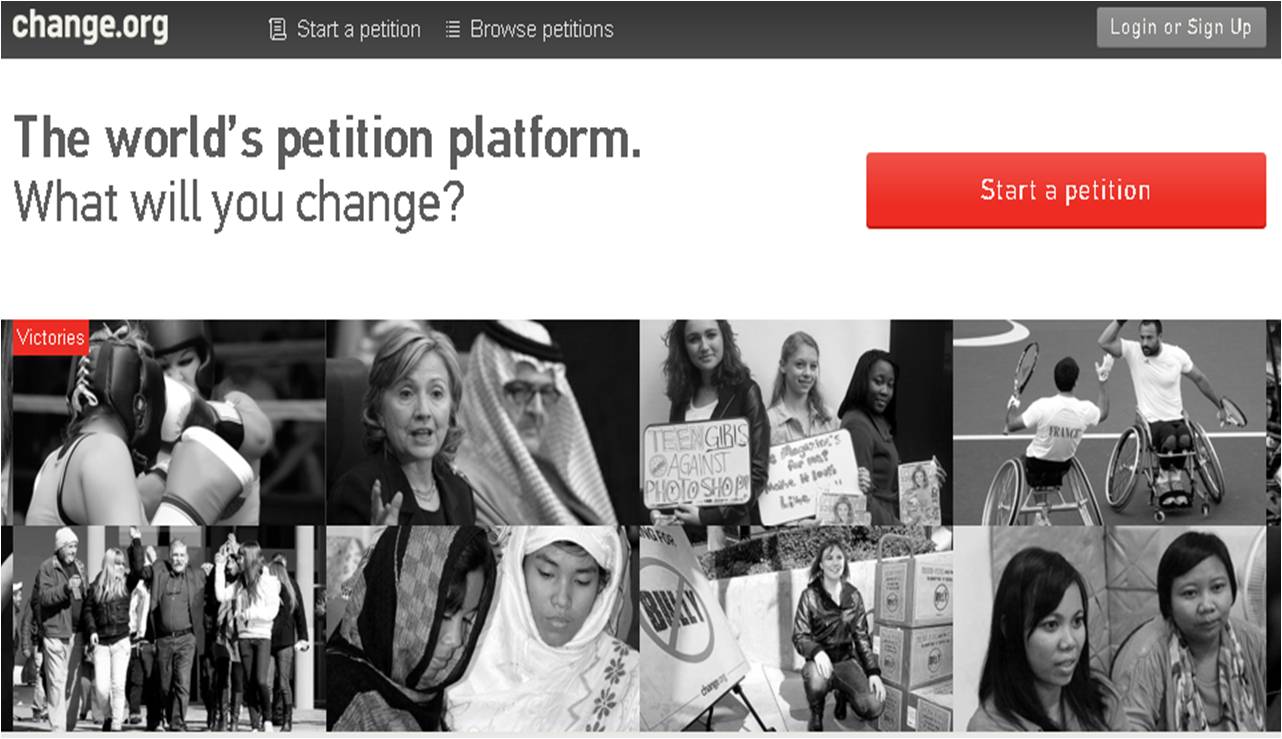
The other example we found together is the website change.org, on this website you can start a petition to change something you are against or on the contrary something you are involved in. It’s a great way to make pressure on few powerful people thanks the greatest number of people. You can share your interests, your actions and your fightings, your struggles and you become aware of the fact that you are not alone. I think it’s a wonderful way to act ethically together in media. 

Image Image Image                  Image


Janne Leivo /Improv everywhere, The Mp3 Experiment

Improv everywhere is a social phenomenon where people in improvise together using the instructions of written beforehand. Charlie Todd, a guy moving to New York years ago, created the idea wanting to make something fun in the streets. The first improve was the “no pants subway ride” which soon lead to many other postings. To ride in I subway is to turn around the general rules of how you should behave in public places.

The important thing about these act are that they are gathering a group of perfect strangers to do something together in a social environment, and all because of making the city a more fun place, one way of being alone together. Every happening is videotaped and posted on a Youtube channel, and the channel has now more than 1,1 million subscribers. The creators are regularly posting new videos and many of the subscribers cant wait for the next video coming out. There are many terms of this kind of behaviour, one is called “flash mob”, but in this case they take the term even further.

In the class we talked about the iZombie, which would mean we turn in to social solitude when we put on our headphones. Improv everywhere has turned this around by making people download an mp3 and make actions with guidance of an instructor They get detailed instructions and gather at the same spot an start the action when the instructor tells them to. The first act is crawl when the instructor says now. Then all the participant crawl and make their spectators look at them wandering what is happening.

These events show us what we should think of the things we see in public. If someone stops you on the street, it is hard to say no, if the message is clear and there is no threat involved. We should always question what is reality and what we want it to be. This tells something about us as humans, we like to have fun whenever we can.

Board Gaming Alone Together

By default, board games are not a solitary activity – you need company to enjoy them. However, this can sometimes be difficult: your best buddy is out of town, your significant other considers your hobby half-insane and the rest are simply not up for a six-hour match of Arkham Horror on a saturday night. So what do you do? You go to shutupandsitdown.com, that’s what.

Shut Up And Sit Down consists of two geeks, Paul and Quinns who have managed to build a board game community around their website, podcasts, Twitter and Facebook. They discuss and review board games in a way that is both deliciously quirky and informative. They reply to almost every reader comment in a similarly quirky way. How do they have time for all this, you ask. Well, they’re proper geeks and therefore have no life, duh.

What is interesting about the site is that it turns a communal activity into something that very much resembles the notion of “alone together” presented on the course. You almost feel like you know Quinns and Paul – heck, you could easily imagine enjoying a few beers with them. The way they talk to their audiences is similar to the way good friends talk to each others at parties after a drink or two.

Of course, the online community does not replace real friends with whom you can actually play the damn games. However, its popularity seems to indicate that it does a very good job at reinforcing the sense of belonging to a secret club of sorts where everyone else is as enthusiastic about the hobby as you are, alone, together.

Tuomas J.
University of Helsinki

Trying to fight corruption alone together

How many times haven’t we worked all alone, together? I don’t know if the “alone, together” term is attributed to Sherry Turkle, but I know that it can apply to more things that we can imagine. For a collaborative paper that people write on Google docs without having never met, to Wikipedia and to online gaming in the form of MMORPG such as World of Warcraft (WoW). And isn’t voting a alone, together act since everyone votes individually? But, let’s leave the last out since it doesn’t include media yet.
My example combines online activism, online protest and crowdsourcing. It is the website of Ipaidabribe in India.
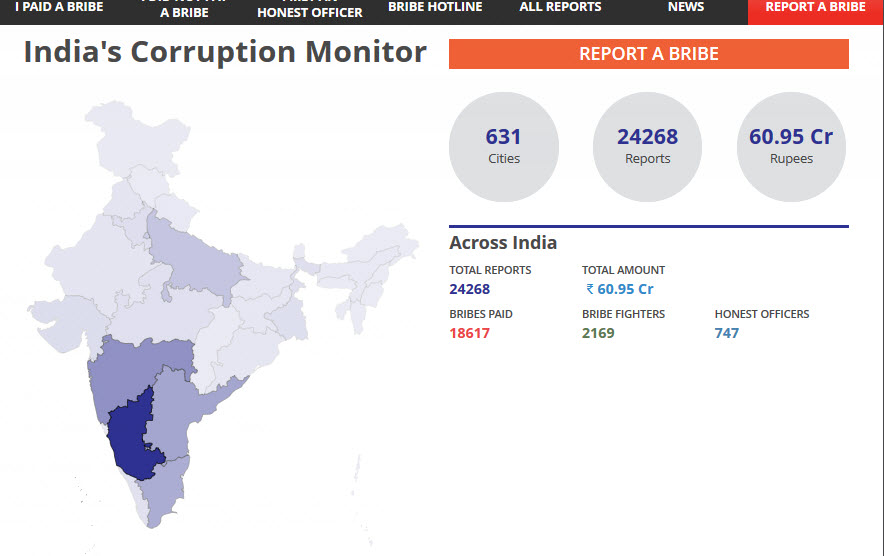
Corruption and bribe seems to be a huge problem in India and this is what the website wants to fight. To be more specific, ipaidabribe.com is a website which goal is to expose corruption and bribery in India. The website was created by Janagraha, a not-for-profit organization that wants to strengthen democracy in India. From its creation till today they have been 24268 reports of priberies in 631 cities. Out of these, 18617 were paid and only 747 of the reports are referring to honest officers.   The citizens can choose to report whether they paid for a bribe, or they asked for a bribe which they didn’t pay or when they met an honest officer. As the statistics of the website are shown, the last case is very rare to happen, or maybe people don’ t feel the need to report when someone is honest, but they prefer to report only those who asked for bribes. Although the reports are anonymous and don’t name the officer who asked for bribery, the system reports the incident to media and government officials and thus it raises awareness of the fact.

paidbribe

Laida Limniati

Being alone together: Wikimarathons and LAN parties

Last year I took part in a Wikimarathon event at my workplace, the Museum of Contemporary Art Kiasma here in Helsinki. The idea of the event was to gather together people from the art world and also Wikimedia activists to produce content considering contemporary art and Kiasma into Wikipedia. The event was quite literally a marathon: we spent consecutively 24 hours inside the museum, even the night when, obviously, the place was closed to the public. I have never been a big computer guy in my life and never felt too savvy with technology. This event was probably the closest that I have gotten to a LAN party. When I was a teenager, LAN events and parties become common in Finland. LAN events are big (or small) gatherings where people create and join a local area network, most usually to play multiplayer computer games together. These kind of events can gather hundreds of people together in one place. The biggest installation here in Finland has been the annual Assembly events held in big exhibition halls, conference centers and sporting arenas.

At the Wikimarathon in Kiasma I felt a weird sensation of mediated experience although at the same time the event was very must built around the notion of being together in a physical space. Being quietly together writing posts created an eerie and I have to say, quite a comical situation where no one talked to each other but communicated via devices. Zombie-ish or what? So why gather if we communicate via mobile and other devices? In my experience the event was about being together, about an extreme experience (spending a long time in a confined space) and to interact on multiple platforms at the same time. Obviously there is some need for people to meet in a physical space although using devices at the same time. Even people who date online ultimately want to meet their date in person. A LAN party or such can feel like a safer environment than the plain “real world”: in a gathering of media devices there is a possibility to be with people but to, also, distance yourself from the immediate reality if you wish so. In a weird way, the Wikimarathon turned out to be a new and weird environment, but also an environment of tolerance and individuality: everyone could easily control their “presence” and there was no pressure of interaction or small talk. (Jaakko U.)

Image 


When we became the most liveable city in the world

Today, when we were talking about being alone and together at the same time in media, it made me think of the change that our dear capital has faced during the past years. I would like to share some points why Helsinki is a great example of the fact that being home alone with our media has actually made us go out more and do things together. This might be because in my 25 years I’ve only been “an active citizen” (interested in things that are happening around me) about five years or so, but I’ve seen a change that social media has given us chance to make in our beloved city. And to prove that it’s not only my feeling, in 2011 Helsinki was rewarded as the most liveable city in the world (and has got other nominations after that as well).

Ravintolapäivä

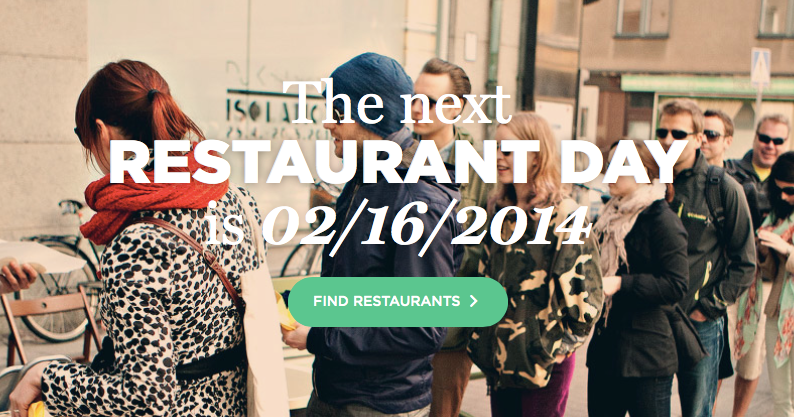
It started with events like Ravintolapäivä (now internationally organized Restaurant Day) and different kinds of block parties around Helsinki. Restaurant day is a great example of these kinds of events; organized thoroughly in social media, people set up their own restaurants for one day and share their location in the web. Today, Restaurant day is a huge event that is organized four times a year and is now followed by such events as Siivouspäivä (Cleaning day) where people gather in different locations to sell their old stuff. Nowadays the amount of different events that take place in Helsinki and are organized in social media  is so huge that in a summer weekend it’s impossible to decide where to go and what to do. There are different markets, concerts, block parties and other kinds of gatherings going on all the time and you won’t be able to visit even a half of them.

Of course, during our long winter time there are fewer things you can do, especially when there’s -10 degrees outside. However, these winter time events are emerging little by little and people maintain this feeling of doing things together and want to cherish it even though it’s cold and dark outside. Maybe it’s due to social media, maybe something else, but nowadays we are using the new media as a tools to make our city a place where we want to spend time and meet other people, not just a space through which we have to go by when heading from one place to another.

– Laura S.

Ana Toledo – The Brazilian NINJAS

The Brazilian journalist collective “Mídia NINJA” (NINJA media) was founded in 2011. The word NINJA is here an acronym for “Narrativas Independentes, Jornalismo e Ação” (Independent narratives, journalism and action) and a play on the concept of the “ninja”.

Image

They have established themselves as an alternative media group since their founding, but rose to prominence mainly during the 2013 Brazilian protests. They have also worked on forceful removal of people done by the State, violence against Native Brazilians populations, police brutality among other issues.

To me they are a good example of working alone and together with a great actual impact. The members, called “ninjas”, go to the place they want to document. Sometimes a member goes alone, sometimes with others, but the idea is that they spread and remain in touch with each other, usually by phone – although, many times they lose the direct contact with each other. Each ninja has a camera, frequently hidden, but smartphones are also used. With the assistance of other people around them or other ninjas, they use wi-fi to live-stream the camera contents. Each ninja has a channel and people can watch the recordings live and comment via twitter. The commenters send message of encouragement but also warnings to other ninjas or to other people who are in the area. Warnings such as “do not go to street x, as there are policemen coming”, “the police is throwing gas bombs in street y”, etc. The ninjas, who are working solo, but actually together, have been a major component in protests and social movements around Brazil.  They are spread in several Brazilian cities and having been doing a lot of coverage. 

They have started small; however, as the protests became more intense, they started to be known by the mainstream. Their channels and content originating from them are constantly spread in social media. Their ascension provoked mainstream media as people could check that their coverage was not very accurate and, at times, incredibly biased. Their content really made and is still making a major impact in Brazil. They have also given alternative media in general bigger public attention and encouraged more counter-narratives to come forward. 


An article on “The Guardian” about the group:

http://www.theguardian.com/world/2013/aug/29/brazil-ninja-reporters-stories-streets

The Midia NINJA live-stream channel:

http://twitcasting.tv/midianinja

Tytti Rintanen – Alone together at night

I have never truly been a great fan of gaming. I guess it’s because my parents never bought us Nintendo gadgets. But, some time ago I had a habit of lulling my brain into sleeping mode by playing a word game on my phone, before starting to sleep. This helped me to put behind the day’s pressure and relax. I guess “I am my father’s son” as also why my dad likes to do crosswords in the evenings. Quite quick I started to get used to the ritual.

Soon it turned out that people are really addicted to that simple word game: no matter what time I went to bed and had my moment of a word puzzle, there were always the same people winning the game. I started to wonder, who are these people? How is it possible that they spend enough time playing the app, for me to run into them almost every evening during my games?

The app would show the number of people online and playing and it happened that several hundreds of people were online even when I’d come home in the early hours, in the middle of the week. I remember the weird sensation of being together with these Finnish people, in the middle of the night, and still being alone in my privacy.

All those people staying up to compete each other on their phone screens…? Every evening? For hours? The zombie theory seems to be alarmingly true, as it explains the thrill of it, I guess. However, I am not interested in growing an addiction and I think random habits are made to be challenged. So I grew tired of the game instead, and deleted the app. But the meetings are still going on in the dark bedrooms, without me, I’m sure.


Mikaela Remes – Vegan January and other Facebook challenges

I didn’t have to look far to find a case of activism done “alone together”, since Vegan January (Vegaanihaaste) has kept me busy this month.

There are several ‘lifestyle’ challenges on Facebook, where people are trying to make the world a better place by small experiments, such as trying out a vegan diet for 30 days. It’s activism-made-easy, it’s just a trial, not demanding lifetime commitment. It’s more than just clicking ‘like’ on a Facebook page; in this case Facebook is used as a tool to gather people to make a practical change in their ‘real’ lives.

vegaanihaasteML

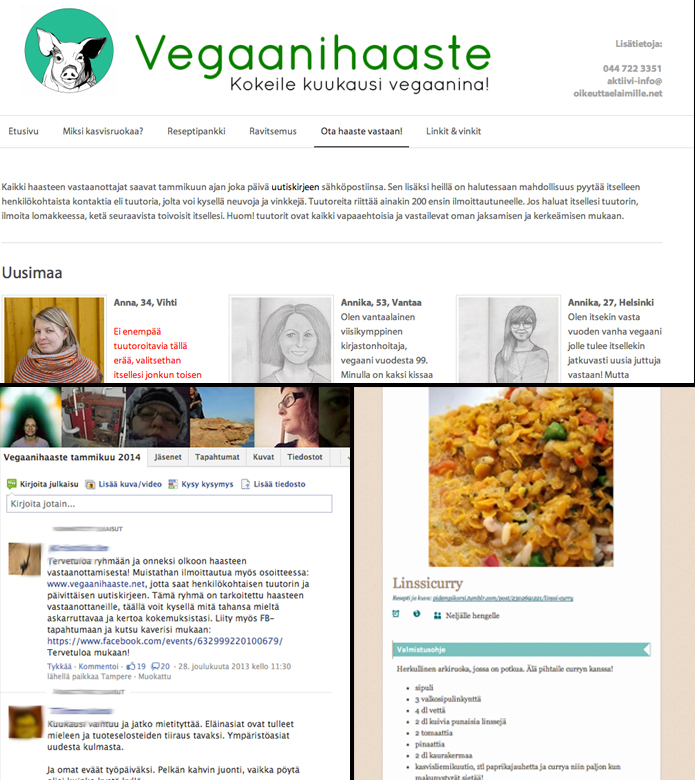
Vegan January has no ‘leader’, it is initiated by a collective of vegans who’ve created a home page for the challenge with recipes and contact information of volunteers that offer (free) consultations for newbies over the internet. You can sign up for a daily newsletter written by the volunteers, containing daily recipes, weekly shopping lists and reflections on a vegan lifestyle. The Facebook group is an important part of this challenge: it functions as a peer support group, where people share recipes, food pictures and discuss problems that they’ve faced. The challenge has been accepted by people of different ages and backgrounds. As the group is ‘closed’ (i.e. you need to be part of the group in order to see what is posted), people are even sharing very personal experiences. So there we are, a bunch of people who don’t know each other, doing our own thing, but sharing thoughts and tips and having our own little community, that will disperse at the end of this month.

Last October, the first Finnish social media challenge made headlines, as two well-known Gonzo-journalists initiated ‘Lihaton lokakuu’ (No-meat November) as a part of their documentary series about global problems and civic society. The No-meat challenge was very successful, its Facebook event gathered 30 000 participants and the recipes that people shared on social media were made into a cook book.

LL_smoothie

Of course people partly join these challenges to get admiration. Nobody knows what is happening on the other side of the screen and certainly there were people among 30 000 participants of No-meat November that kept on eating meat every day. But there were also loads of people who were actually challenging themselves, actually trying out a new kind of diet and defying their prejudices towards veggies. After the challenge month, people parted in different directions and many continued their previous lifestyle. But all participants  had fun for a month, sharing an interesting experience, and that in itself is valuable.