Tiiu Särkijärvi – Seems that I’m 16 (totally embarrassed now)

The first link I open in Google to find out my true identity is LinkedIn. I can see my work history and education background, at least I think it’s mine, as there’s no picture.  I cannot access the whole profile without signing in. The next one is Facebook. I can only access my background and personal photo, but nothing else without logging in. From the pictures I can gather that I have a thing for Shrek and creepy old houses.

The next one is Twitter (which I know will be my downfall. I have actually used Twitter to vent all my frustrations about life instead of Facebook as nobody follows me on Twitter and I don’t want some of my Facebook “friends” to know if I’m not doing okay). But what do you know, my account is protected!!! Nobody who has not logged into Twitter can access my information! Twitter allows people to see my photo, where I smile and a background image of New Zealand.  I also have a Twitter username: Stiidu, which sounds like a pathetic rapper from the suburbs of Helsinki (actually a nickname given to me in junior high). There is a line of text under my picture, where I seem to promote “clean living with candy”, whatever that means.

The next one, which I didn’t expect at all is my account in Goodreads. The page actually shows my account information, for example, my favorite books. This is information that I wouldn’t want anyone to see, not that any of the books are scandalous, but because it’s private. I seem to have a thing for fantasy. I am not comfortable with this.

Next one gives me so much anxiety. It’s my Pinterest account (I had forgotten that I even have a Pinterest account). I actually have a board called “Rocker wall”. I want to die. This is so embarrassing. You can actually find out a lot about me. I have four walls. One is for interior design, one is for clothes, one is the rocker wall and one is labeled inspiration and imagination. I seem to dig rockers and landscape photos. I feel so stupid. This is super embarrassing. I hope I can privatize this account somehow so that nobody sees this. Ever. This Pinterest account was supposed to be super-private and here it is, available to everyone. I’m sitting at home alone and I’m red as a beet.

As if this wasn’t embarrassing enough the next one is my stupid Twitter nickname combined with all the pins I have on Pinterest. This is because I use my Twitter account to access Pinterest.

Then there is Twitter statistics, two links to Prezi, where I have created a test-prezi, which doesn’t really show anything but a cartoon character from the movie Madagascar and a link to a Finnish service providing contact information, which says there is no contact information under my name.

Well, for me this exercise definitely proved a point. You can actually get a pretty detailed picture of who I am as person mostly via Pinterest and Goodreads. My whole CV is available on LinkedIn and I get really anxious about all of this. I need to look into how I can limit peoples’ access to these accounts better. I thought I was trying to be private and protect all my information, but what I actually found out was that I am an open book, against my better knowledge. Based on my pins and Goodreads, I’d get the idea I’m about 16 years old. If you look at LinkedIn, it tells a different story of a person, who has actually had pretty decent jobs. The information contradicts itself quite badly.

I leave you with a screenshot of Goodreads, the Rocker Wall is just too damn embarrassing.

media life


Janne Leivo /Who you are in the Internet world

To suffer from memory loss, amnesia is a horrible thought. My first thought that came to my mind is the film The Bourne Identity. The main character of the film, Jason Bourne suffers from amnesia after an assassination attempt and has to figure out who he is. Gradually he finds out he is former trained assassin with skills not an everyday guy would have.

In today’s lecture we talked about the importance of the electronic trace you leave behind. In a world were everyone has a degree and are capable of doing remarkable things, does the Internet say who you really are and what you can do, and this is good question. If we look at an unknown person on the street, we can’t say if the person has any special skills, we don’t know there was just a world famous pianist walking by. If I would have to trace back memories or history of me, I would possibly find out that skills in skateboarding and juggling, or another motoric skill. This reminds me off my grandfather, he used to be quite skilful juggler, but since I never got to know him, I have no memory of him. And since it was a long time ago, they did not have access to video cameras to document my grandfather’s skills juggling in a performance. I only recently discovered the talent my grandfather did have, and if I had started practicing juggling at an early age, I would today be a master and maybe have some postings online of me making a performance. This comes back to the question of who we are trying to be and what we can do about it.

María Hernández – who I am according to Google

My total amnesia made me curious about my own life, so I tried to discover myself by looking for my name (the only information I have about me) on the internet, and this is the result:

The first thing I get to know is that I have a very common name. In order to find myself in Google, I first have to click on three other profiles of women called María Hernández Solana. Once I find the right one, which I recognize because of the picture, I go into my Linkedin profile; the only things I could learn about me from this profile is that I study Journalism and I have been involved in several projects, in addition to the fact that I have done two internships related to graphic design.

From my Facebook profile I could only see three or four profile pictures, all of them in very sunny and nice places.

So the only thing I now know about myself is what I do profesionally speaking and that I love the sun according to my profile pictures.

After this experiment I reach the conclusion that it is quite difficult to know my personal details just with a simple Google search. I guess that a more in depth search would have different results, but now I know that it is not very easy to find out who I am in the internet.

About the question of who I am trying to be, if I had to understand myself only from this search, I would have the feeling that the most important thing is my work and that I want to have a happy and responsible image towards the others. I guess that I am trying to be perfect for a future job, like many other people do.


Jete Laanemägi – In the process of stalking myself

Total black-out.

Facebook – assuming that amnesia caused me to forget my Facebook password, there is really nothing much to look at. All I see is a bunch of cover photos. From them I can sum up that supposedly I snowboard, have at least 2 friends who take pictures with me, watch anime and like to run down the stairs. Oh yeah and I’m female. And like wolves I guess.

Instagram – nothing. Youtube – the same.

Google – seems that I wrote my Bachelor’s thesis about the language used in Cuban hip hop music. I have given aerobics lessons. I do a lot of sports and take part in a lot of competitions – especially in skiing and swimming. When I was in the 6th grade, I ran 2500 meters with 12 minutes and skied 2 km with 10 minutes.  And it seems I love going to punk and metal rock concerts.

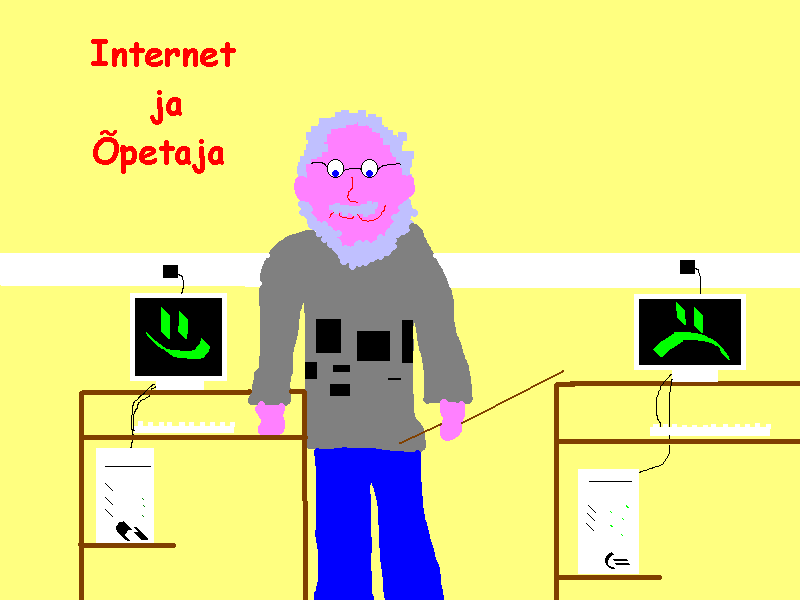
And oh yeah, I guess I was an award winning and talented artist when I was 10 years old. This is my drawing that supposedly took part in some kind of a competition. It’s named “Internet and Teacher”. Just look at the sad computer there. Amazing.

Image

Janne Leivo What song are you listening to?

I find myself constantly looking at people in the streets with their headphones on and wondering what they are listening to. Then I found this video, started in New York a few years ago. This filmmaker wanted to stop people on the streets, and ask them what music they are listening to in their headphones. Then he edited the video so that the music starts to play after the question is asked.

Music has been around for ages, and knowing what someone is listening to tells a lot about the person. The video started out in New York but spread fast to other countries and it is interesting to see how people in other countries respond to the same question “what song are you listening to”. The responses even tell much about the city they are living in, you can sense the in what kind of speed people are moving and how they are interacting with each other.

To get a large number of audience, you want to make media, which people can relate to. This example is a video getting an international audience, and telling a lot about the everyday life on the streets. This video shows us what it is to live in a city. You can walk around without being disturbed, and to erase the noise of the city you hide behind your headphones and your music. If someone asks you about what song you are listening you, it should not be a big deal. It only makes common understanding of humanity.

In the class we talked about how media has disappeared. Media has indeed disappeared with people walking on the streets with their headphones on. The music has become a part of the urban wanderer, the flâneur.


New York, the original video, 2 629 845 views


London, the follow up, 638 483 views

Noora Happonen – Unreal tourist photos

In class we talked about how media changes our concept of reality. We are looking at reality as something we can edit and we speak about in “media terms” such as freezing, fast forward, rewinding etc. We saw some examples of pictures inspired by Harry Potter and Star Wars, where people acted in real life as the heroes of these stories.

This reminded me of a type of tourist photo people take where the reality is somehow unreal and looks manipulated. You know, the ones where you lean against the tower of Pisa as if holding it up. One especially good example are the photos taken at Salar de Uyuni, a salt flat in Bolivia. The large area, the blue skies and the incredible flatness of the place makes it a perfect spot to take unrealistic photos that seem to be from a movie. Or what do you think of these: http://mashable.com/2013/10/22/salar-de-uyuni-instagram/

I think that these photos are a good example of how people want to play with the reality, challenge the limits of what is considered possible and impossible in the real world compared to media. Also they make ordinary tourist photos much more fun and extraordinary – and who wouldn’t want at least occasionally reality and their life to be more fun and extraordinary?

I want to be a superhero

When I was a kid I remember watching the TV shows. I used to spend hours in front of the scream.

For me, that was the best entertainment, since my mom would not let me out that often to play with the other kids on the streets. As the time passed by, and the violence rate increased (in Brazil) along with the technological development, it became more and more common that kids spent their times indoors and were entertained by media.

The media, then became, to me, a reference to do my daily tasks. I remember catching up I had seen on the cartoons and trying to apply in real life. I thought I could do anything that I had watched.

As I did imagined I could do anything I watched on TV when I were a kid, children, nowadays, also do. It’s very common to see children begging to their parents for school materials, clothes and toys from their favorite heroes, or having a birthday party which the theme is a cartoon. I guess the child wants to be as awesome as the character they see on media.

Although, not only having material things from their favorite character seems to be enough to some children, since those will wish they could be the character itself. For example, this child from England became a success on the internet imitating Hulk http://mais.uol.com.br/view/s70pk4i6az2h/menino-de-2-anos-vira-sucesso-na-internet-imitando-hulk-04024D1B3462C0813326?types=A&. There were news around all over the world about it.

Therefore, those children could, in fact, become famous as the character and, in a certain way, make their dream come true. In others cases, though, the children can go beyond and try to be a superhero that can fly, such as superman or batman. Their sense of reality in these cases would truly miss up with is watched on media and what they live in real world. Every now and then we see the news about children that tried to fly as a superhero, sometimes causing terrible accidents.

Watching TV in the childhood can influences a lot in the raise of the children since they are constructing their sense of reality. It influenced me as a child and it still does with other children.

Fernanda Conforto de Oliveira – Media Life 2014

Chore Wars & Alternative Reality Games

Does your room look messy all the time? Do you have a hard time convincing your kids to do the dishes? Oddly enough, there is an Alternative Reality Game for that. In Chore Wars, you’re not only taking the garbage out or cleaning up the toilet seat – you’re also leveling up and slaying deadly beasts.

I feel that Chore Wars, among with other ARGs, is a prime example of people using media to change their reality, to make it more epic.

This peculiar, if already quite dated-looking little game can be found here.

Tuomas J.
University of Helsinki

Express yourself/ Ida Sjöman

This is an advert that I came across, I think last year, many times. It is a Windows touch screen computer add.

I find this add intriguing because it shows a little girl first pondering what do. She seems to be bored with her “old school” blackboard and chalk. After her mother kindly replaces the blackboard with a widescreen touchpad she starts to express herself. She is able to draw multiple images in a matter of seconds and her mother is placing them on the wall as she goes. I think that this advert carefully uses the “old” ideas and combines them with the introduction of the “new”. Meaning, it shows that with the old medium (blackboard) the girl has reached her creative potential but with a digital device she is able to develop her ideas further and “old” in the sense that the images still need to be printed out, physically, and placed on the wall. So the images can still be enjoyed in their physical form.

During her artistic moment, the girl also receives a phone call, or better yet a Skype call from her dad. She takes the call by naturally gliding the answer button so that her fathers face appears on the screen where her drawing was just a second ago. In so many ways this advert is promoting new ideas in digital media life and the promise of an endless creativity but it is still old in the sense that we already know the story. Children have been bored before, they have drawn before, mother is home taking care of the kids while the father is at work earning money. It seems that this way it is easier for the consumers to digest the digital development and the fact that there is no escape. This way it is safe and familiar, same activities just a new blackboard.

Needless to comment on the catchy tune on the background which reminds us to “express yourself”!

Mikaela Remes – Bitcoin

Yesterday’s discussions about the desire of us humans to edit our reality made me think about the virtual currency called Bitcoin.

BTC is a digital currency based on open source code that was developed by someone by the screen name of Satoshi Nakamoto in 2008. Bitcoin users utilize cryptography to send and receive money (bitcoins) through software. Bitcoin emerged as a free market currency, as a response to frustration against the power of the banks; Born out of the ashes of the global financial crisis, bitcoin is a nerd’s way of flipping the bird at society.

The currency has been heavily criticized, since it is known to be used for criminal activities, such as purchasing drugs on online black markets. It has been called a bubble and “the most dangerous technological project since the internet itself”The European Banking Authority has warned that Bitcoin lacks consumer protections.

Time will tell whether Bitcoin is a “real” option to the system or if it will remain a protest. Still, it is an example of what people can do if they decide that they do not want to stick to the system and that is possible to “hack” a field that is dominated by institutions that a regular person might feel he or she has no power to influence.